
Disrupting Sports Broadcasting
The transition from analog (traditional CCTV) cameras to IP cameras revolutionized the security & surveillance industry in the last decade. In the consumer sector, Dropcam enabled home monitoring from anywhere in the world at anytime. In the enterprise space, IP Cloud surveillance enabled managing and monitoring large scale environments such as airports, shipping ports, stadiums, borders, casinos and even entire cities from anywhere in the country.
In the computing world, IP technology transformed self-managed, locally hosted and expensive hardware infrastructure into Cloud hosted, fully managed computing storage. All while being accessible from anywhere at the rate of pennies per hour. Specialized resources that were once within reach of large enterprises are now available to small and medium enterprises as well. In a sense, virtualization brought the democratization of computing infrastructure.
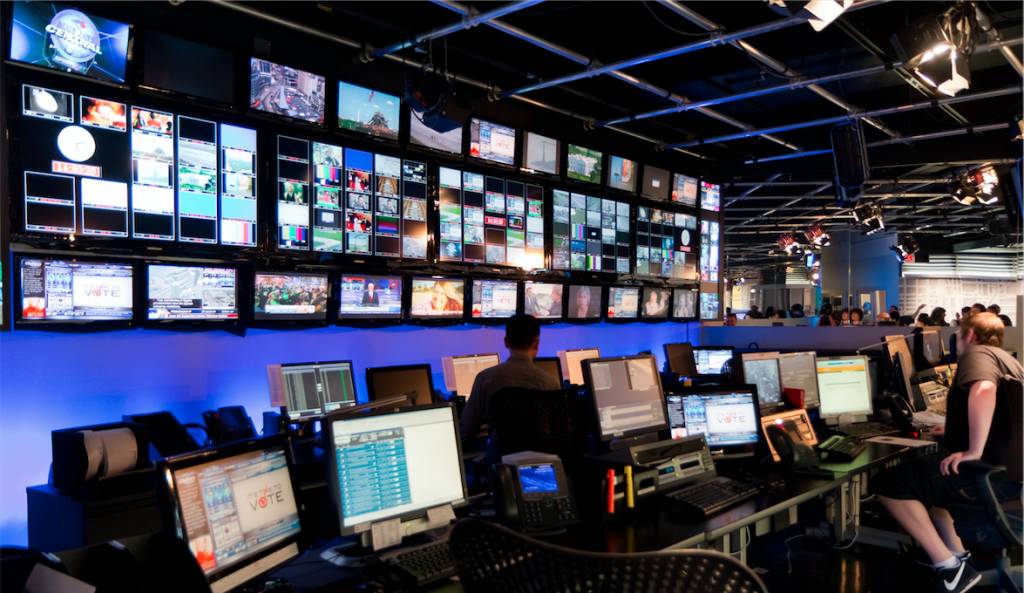
Does IP technology hold the same promise for sports production & broadcasting? The traditional self-managed computing world has several parallels to the current world of sport broadcasting. A professional sport broadcast uses specialized camera equipment, expensive and specialized hardware workflow for mixing and graphics inside a production truck and a team of professional crew centrally managing the entire show at the venue.
Can IP technology enable virtualization and decentralization of the production workflow? Where, the replays are created by a crew in Lincoln, Nebraska, the yellow 1st down line inserted by crew in Hamilton, New Jersey, player and game stat graphics from New York, and direction & commentary from Bristol, Connecticut. The cloud manages the distributed workflow and the production infrastructure is available for dollars an hour. This solution is not just for NFL games, but the entire spectrum, from professional sports to high school games. Essentially a virtual production truck…
Can IP technology enable remote camera control? Where camera operators are following the ball with joysticks similar to remote control of drones or a doctor performing remote surgery. Where, the mid-field and end-zone cameras operators are distributed across the country. The camera operators and production crew best suited for the task are selected from pool of talent wherever they are available, without need to travel to the venue. A virtual camera man …
With virtual production and virtual camera operations, there can be an order of magnitude savings in cost and increase in scalability. But how about quality? Quality has multiple dimensions, quality of cameras, resolution, number of cameras angles and perspectives, ability to follow the game, commentary, graphics, and a CREATIVE element. Any solution will have to preserve the quality while preserving the cost and scalability benefits accorded with transition to IP.
At Strive, we are creating the next revolution in broadcasting with 4K technology and cloud based infrastructure for remote production. Stay tuned for additional coverage on this blog.
February 12, 2016 | StriveCast.tv | By Manoj Aggarwal